Sunday, 10 June 2012

a right royal do

As previously discussed, I love the Queen. I think she's a remarkable woman who lives a remarkable life; privileged, public and, I imagine, often very lonely.

Imagine, then, my surprise and delight when I find out that my mum has been nominated by a colleague to be invited to the National Service of Thanksgiving at St. Paul's Cathedral in London for the Queen's diamond Jubilee, and she wanted me to be her plus one!

In fact, there I am, next to the Queen herself:
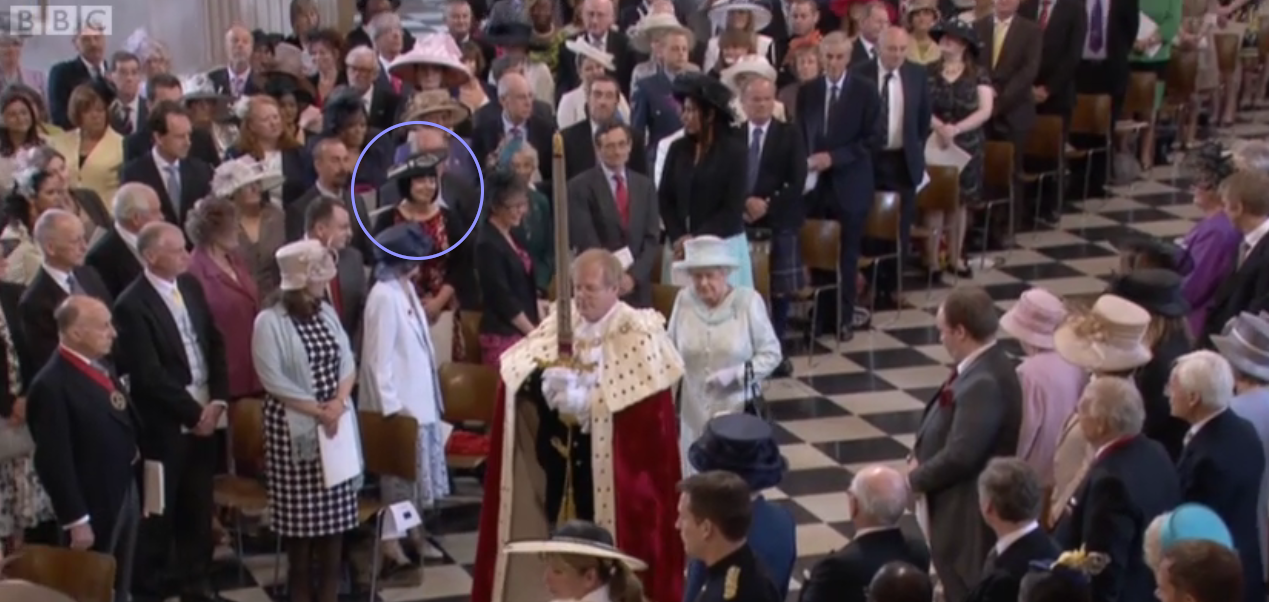
It was, quite literally, one of the most surreal moments of my life. For a start, never having been in the Cathedral before, St. Paul's was overwhelmingly beautiful. We assumed that, as part of the pleb contingent, we'd be allocated seats that were stuck behind some pillar somewhere, so we got there good and early in the hopes that we might actually get to see what was going on.

Being the youngest member of the congregation by a good couple of decades helpfully meant that even 7.45 was a bit too early for most of the old dears, so we were incredibly lucky to get prime aisle-side seats just before the dome. 

The whole thing was utterly, utterly glorious and surreal. From the household guards with their huge domed helmets draped in white ostrich feathers to the Alice in Wonderland-esque heralds with their Royal Standard tunics, black tights and blue birds on the end of long black sticks, it was altogether well outside of my everyday experience.

Seeing Harry, William and Kate (who, by the way, gave me and Mum a little grin and a nod as she was walking back down the aisle -- probably due mainly to the fact that Mum and I were beaming from ear to ear, unlike seemingly everyone else...) was probably the strangest and most exciting bit. They're so oddly familiar, you've seen their faces so many hundreds of times before in newspapers and on the TV, that seeing them in real life felt truly bizarre. We all, the outsiders, have been privy to so many of their private moments -- weddings, funerals -- that we feel almost as though we know them.

I remember hearing the crowds outside roar with cheering and clapping when they all arrived (as well as chanting 'Long live the Queen, long live the Queen' again and again as she got out of the car -- that bit made me cry. Quite a lot), and feeling so much a part of something, something huge and historic.

There is lots, lots more I could say -- about leaving the Cathedral surrounded by screaming crowds and lights and cameras and film crews; about the lunch reception at the Guild Hall with stairways flanked by soldiers wearing armour, actual armour, and holding muskets and pikes -- but I won't. It sounds like I'm showing off, and I'm not. I'm so completely awestruck by the whole thing that only when I watched it on BBC iPlayer did I really believe that I was there at all.

It was an honour to be there, and I felt completely privileged to be part of it.

Sunday, 6 May 2012

Friday, 17 February 2012

"tell us lots of stories"


Last weekend my brother and his mate came to stay, and we made a couple of trips to a couple of pubs with my friends. Now, anyone that knows us (and, to be honest, some who don't) knows that my family is into telling stories, and that my brother is a remarkably good storyteller.

We all sat round a table in this quirky little pub that I love in Newcastle, watching him as he told endless stories about what it's like to be a 17 year-old in high school -- what it's like being a 17 year-old full stop, something that my friends and myself have to look increasingly far back in time to remember.

My brother isn't a quiet bloke at the best of times, but he really comes alive when he's telling a story -- he tells it with his whole face, his accent, his hands. It's an absolute treat to watch and, needless to say, I was beaming with pride.

Storytelling isn't something that we think about all that much. If someone says 'story', you tend to think of a child's story in a book, or something generally made-up.

This is how Google defines a story:
sto·ry
noun
account of imaginary or real people and events told for entertainment
 'Real people' -- that's the key. We forget that the day-to-day way we relate to each other is made up almost entirely of stories of one form or another. Often it's as much about the way we tell a story as the story itself. I know first hand -- I might try and tell one of my friends one of my brother's stories, keen that they experience it for themselves, but find that I don't tell it in half as entertaining a way as he can.

The other week a group of mates and I got together and we ended up sharing bits of our life stories with each other. We just went round the circle really, everyone sharing something. I tell you, you could have heard a pin drop whenever anyone was speaking.

The stories themselves were amazing, but no less interesting was the way people told them. Some said a lot, some said only a little; some blushed, some didn't; some punctuated with hand gestures, others kept their eyes down. I don't think anyone would have called it that, but we were storytelling.

My housemate is hosting a girls' youth group in our living room this evening -- I can hear them in there, hooting and shrieking away. My housemate recently came back from a 3 week trip to Australia, she was glowing and brown and bursting with new tales to tell. When her girls arrived this evening, they all piled into the living room, sat down and said:

"How was Australia? Tell us lots of stories!" 
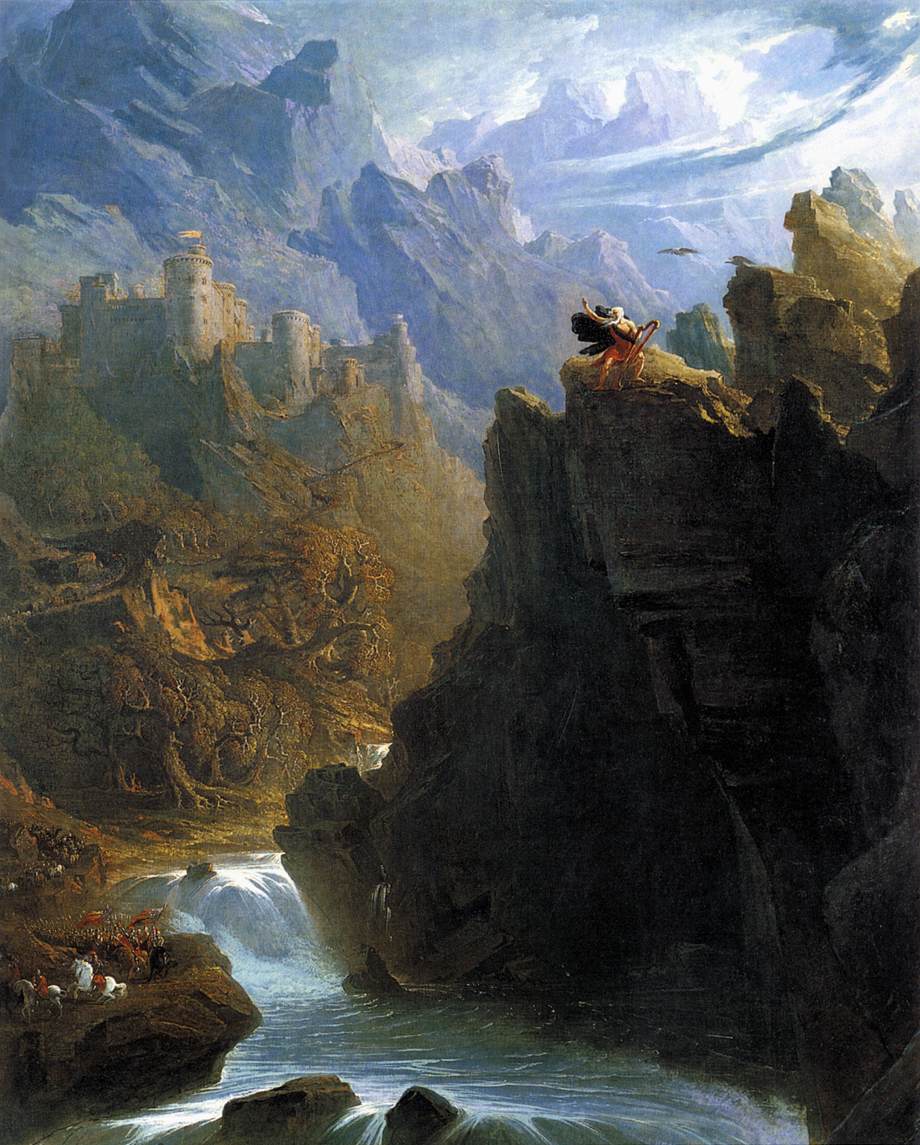
The Bard -- John Martin

I suspect she still is, with those teenaged girls all gathered round, enthralled.

Storytelling used to be much more engrained into culture, far more formalised and recognised for its deep, deep importance. Troubadour. Bard. Minstrel. Poet.

This painting is one of my most favourites. It's by John Martin and is called The Bard. It illustrates a time in Welsh history when Edward I attempted to kill Welsh culture by murdering any bards he could find. Back then, storytelling was a truly crucial part of society -- word of mouth was the only record of life that ordinary people had.

Google it to see it in full size and look at the way the bard is drawn -- he's like a piece of the landscape, clinging to a craggy rock face, muscle-bound and grey-bearded, steeped in history, looking Zeus-like, godlike on the cliff face. So much bigger than the tiny soldiers below -- the proportions of the painting are blown by his bigness, his absurdly huge form. But what a figure! He beams power and force and defiance. Storytelling more powerful, even, than an army.

Storytelling is a huge part of our society still, but often the telling of our own histories rather than the collective. Blogging itself is storytelling. We're all obsessed with telling our stories, chronicling our lives -- Facebook, MySpace, diaries, journals.

Facebook is now encouraging us to create a visual story of our lives, omitting no detail. Personal stories are so laughably readily available to us, so eagerly broadcasted.

We think so little of sharing our stories with literally thousands of people that we often don't realise we're doing it. I don't necessarily think it's a bad thing to be so overwhelmingly connected to people, but it is good to know that there are some things that just can't be communicated as well as face-to-face. Watching my brother tell his stories will never, can never, be rivalled by a blog post or status update.

No particular conclusion to this one, just -- tell stories! Revel in them! Write them down! It feels good to know that we're doing just the same as we've been doing since people began.