Monday, 6 May 2013

a few lovely things

Hello blog. It's been a while.

To get me back into the swing, I thought I would talk about a few things that I really like. Namely - a coffee shop, a song, a poem and a view.

1) The coffee shop

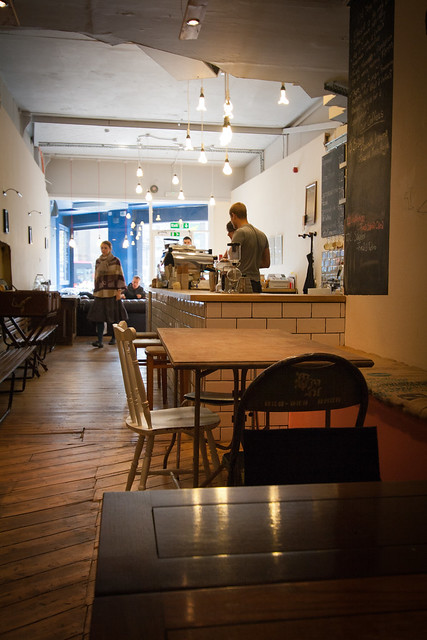
One of my favourite cafés in Newcastle is Pink Lane Coffee - a v.trendy but unpretentious spot opposite Central Station.

So named as it's at the bottom of a little hill called Pink Lane, it would be quite easy to walk past this little gem. They've done the interior beautifully and, as someone who hopes to one day to open a café (although these days, who doesn't?) I really admire their carefully sourced, unusual wooden furniture and some lovely little finishing touches.

Examples: all the teacups are different (gold star from me), you get your milk in teeny little glass bottles with silver screw-top lids, the cushions on the squishy leather sofas in the window are covered in old coffee sacking. Nice.

The coffee is beautiful and very carefully chosen and roasted in-house, the paninis are v.tasty (recommend the houmous, red pepper, rocket and jalapeño), the staff are really friendly. In short, it's the kind of place you could sit all day, grazing on coffee and gorgeous cake, without feeling like they're trying to bustle you out or that you're out of place without a MacBook and an in-progress screenplay.

2) The song

Now, truth be told, the only reason I know about this one because it was listed in the regular 'mixed tape' page in this magazine.

But I'm glad it was. 'Sticks and Stones' by Siskiyou is a lovely little song, putting me in mind of fresh summer days and exploring new places. I think it may make an appearance on my summer playlist this year.

3) The poem

Not the whole poem, but a lovely part:

For I have learned
To look on nature, not as in the hour
Of thoughtless youth, but hearing oftentimes
The still, sad music of humanity,
Nor harsh nor grating, though of ample power
To chasten and subdue. And I have felt
A presence that disturbs me with the joy
Of elevated thoughts; a sense sublime
Of something far more deeply interfused,
Whose dwelling is the light of setting suns,
And the round ocean, and the living air,
And the blue sky, and in the mind of man,
A motion and a spirit, that impels
All thinking things, all objects of all thought,
And rolls through all things. Therefore am I still
A lover of the meadows and the woods,
And mountains; and of all that we behold
From this green earth; of all the mighty world
Of eye and ear, both what they half-create,
And what perceive; well pleased to recognize
In nature and the language of the sense,
The anchor of my purest thoughts, the nurse,
The guide, the guardian of my heart, and soul
Of all my moral being.

Lines Written a Few Miles Above Tintern Abbey
-- William Wordsworth

Which leads me on nicely to...

4) The view

So, after work last Friday, my housemates and I went camping near Bamburgh in Northumberland. 

On the Saturday morning I woke up at 6.30 and couldn't get back to sleep, so I got up and went for a little wander along a lane heading towards the sea. So beautiful! Everything was glowing with that gorgeous early morning gold light and the birds were singing and, oh, the air was so delicious.

Later that day we went for a proper wander along the coast towards Bamburgh Castle, and look, look how beautiful it was! Lots of sighing happened.


So there you have it. 4 lovely things.

Tuesday, 15 January 2013

unphotographable*

This is a photo I did not take of a quiet, smiling young soldier on a train. Lucozade in one hand, high-fiving a gurgling, red-cheeked baby with the other - over and over again.

*An idea pinched from this excellent place.

Saturday, 29 December 2012

Sunday, 10 June 2012

a right royal do

As previously discussed, I love the Queen. I think she's a remarkable woman who lives a remarkable life; privileged, public and, I imagine, often very lonely.

Imagine, then, my surprise and delight when I find out that my mum has been nominated by a colleague to be invited to the National Service of Thanksgiving at St. Paul's Cathedral in London for the Queen's diamond Jubilee, and she wanted me to be her plus one!

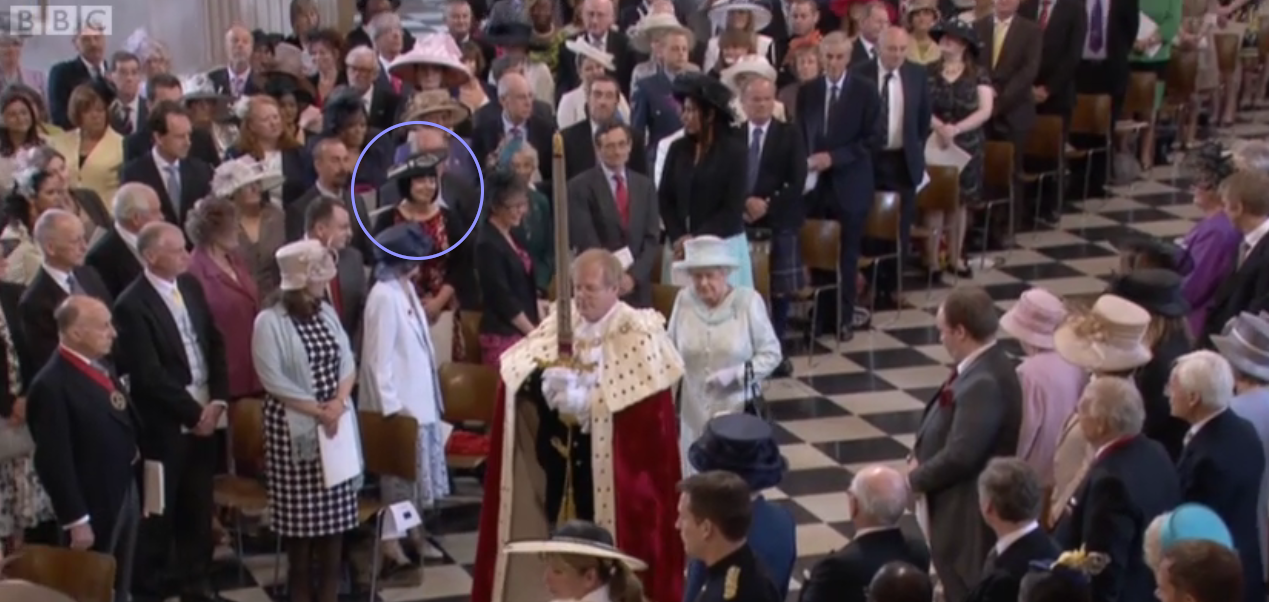
In fact, there I am, next to the Queen herself:

It was, quite literally, one of the most surreal moments of my life. For a start, never having been in the Cathedral before, St. Paul's was overwhelmingly beautiful. We assumed that, as part of the pleb contingent, we'd be allocated seats that were stuck behind some pillar somewhere, so we got there good and early in the hopes that we might actually get to see what was going on.

Being the youngest member of the congregation by a good couple of decades helpfully meant that even 7.45 was a bit too early for most of the old dears, so we were incredibly lucky to get prime aisle-side seats just before the dome. 

The whole thing was utterly, utterly glorious and surreal. From the household guards with their huge domed helmets draped in white ostrich feathers to the Alice in Wonderland-esque heralds with their Royal Standard tunics, black tights and blue birds on the end of long black sticks, it was altogether well outside of my everyday experience.

Seeing Harry, William and Kate (who, by the way, gave me and Mum a little grin and a nod as she was walking back down the aisle -- probably due mainly to the fact that Mum and I were beaming from ear to ear, unlike seemingly everyone else...) was probably the strangest and most exciting bit. They're so oddly familiar, you've seen their faces so many hundreds of times before in newspapers and on the TV, that seeing them in real life felt truly bizarre. We all, the outsiders, have been privy to so many of their private moments -- weddings, funerals -- that we feel almost as though we know them.

I remember hearing the crowds outside roar with cheering and clapping when they all arrived (as well as chanting 'Long live the Queen, long live the Queen' again and again as she got out of the car -- that bit made me cry. Quite a lot), and feeling so much a part of something, something huge and historic.

There is lots, lots more I could say -- about leaving the Cathedral surrounded by screaming crowds and lights and cameras and film crews; about the lunch reception at the Guild Hall with stairways flanked by soldiers wearing armour, actual armour, and holding muskets and pikes -- but I won't. It sounds like I'm showing off, and I'm not. I'm so completely awestruck by the whole thing that only when I watched it on BBC iPlayer did I really believe that I was there at all.

It was an honour to be there, and I felt completely privileged to be part of it.

Sunday, 6 May 2012

Friday, 17 February 2012

"tell us lots of stories"


Last weekend my brother and his mate came to stay, and we made a couple of trips to a couple of pubs with my friends. Now, anyone that knows us (and, to be honest, some who don't) knows that my family is into telling stories, and that my brother is a remarkably good storyteller.

We all sat round a table in this quirky little pub that I love in Newcastle, watching him as he told endless stories about what it's like to be a 17 year-old in high school -- what it's like being a 17 year-old full stop, something that my friends and myself have to look increasingly far back in time to remember.

My brother isn't a quiet bloke at the best of times, but he really comes alive when he's telling a story -- he tells it with his whole face, his accent, his hands. It's an absolute treat to watch and, needless to say, I was beaming with pride.

Storytelling isn't something that we think about all that much. If someone says 'story', you tend to think of a child's story in a book, or something generally made-up.

This is how Google defines a story:
sto·ry
noun
account of imaginary or real people and events told for entertainment
 'Real people' -- that's the key. We forget that the day-to-day way we relate to each other is made up almost entirely of stories of one form or another. Often it's as much about the way we tell a story as the story itself. I know first hand -- I might try and tell one of my friends one of my brother's stories, keen that they experience it for themselves, but find that I don't tell it in half as entertaining a way as he can.

The other week a group of mates and I got together and we ended up sharing bits of our life stories with each other. We just went round the circle really, everyone sharing something. I tell you, you could have heard a pin drop whenever anyone was speaking.

The stories themselves were amazing, but no less interesting was the way people told them. Some said a lot, some said only a little; some blushed, some didn't; some punctuated with hand gestures, others kept their eyes down. I don't think anyone would have called it that, but we were storytelling.

My housemate is hosting a girls' youth group in our living room this evening -- I can hear them in there, hooting and shrieking away. My housemate recently came back from a 3 week trip to Australia, she was glowing and brown and bursting with new tales to tell. When her girls arrived this evening, they all piled into the living room, sat down and said:

"How was Australia? Tell us lots of stories!" 
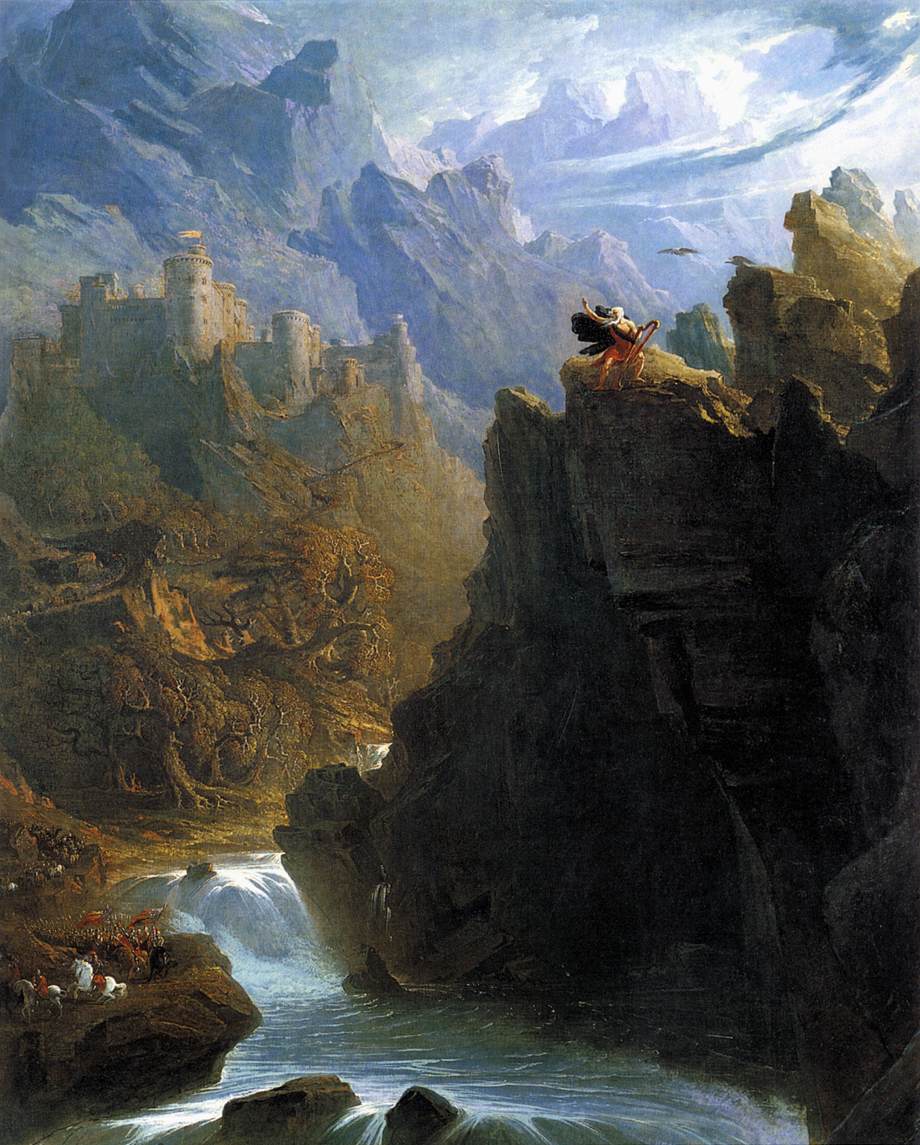
The Bard -- John Martin

I suspect she still is, with those teenaged girls all gathered round, enthralled.

Storytelling used to be much more engrained into culture, far more formalised and recognised for its deep, deep importance. Troubadour. Bard. Minstrel. Poet.

This painting is one of my most favourites. It's by John Martin and is called The Bard. It illustrates a time in Welsh history when Edward I attempted to kill Welsh culture by murdering any bards he could find. Back then, storytelling was a truly crucial part of society -- word of mouth was the only record of life that ordinary people had.

Google it to see it in full size and look at the way the bard is drawn -- he's like a piece of the landscape, clinging to a craggy rock face, muscle-bound and grey-bearded, steeped in history, looking Zeus-like, godlike on the cliff face. So much bigger than the tiny soldiers below -- the proportions of the painting are blown by his bigness, his absurdly huge form. But what a figure! He beams power and force and defiance. Storytelling more powerful, even, than an army.

Storytelling is a huge part of our society still, but often the telling of our own histories rather than the collective. Blogging itself is storytelling. We're all obsessed with telling our stories, chronicling our lives -- Facebook, MySpace, diaries, journals.

Facebook is now encouraging us to create a visual story of our lives, omitting no detail. Personal stories are so laughably readily available to us, so eagerly broadcasted.

We think so little of sharing our stories with literally thousands of people that we often don't realise we're doing it. I don't necessarily think it's a bad thing to be so overwhelmingly connected to people, but it is good to know that there are some things that just can't be communicated as well as face-to-face. Watching my brother tell his stories will never, can never, be rivalled by a blog post or status update.

No particular conclusion to this one, just -- tell stories! Revel in them! Write them down! It feels good to know that we're doing just the same as we've been doing since people began.

Sunday, 29 January 2012

the best thing


So I've been listening to an album by Port Isaac's Fisherman's Friends fairly solidly for the last week -- I'm still not tired of it. I love sea shanties. I really love them.

I understand that they might not be everyone's cup of tea, but I think they're bloomin marvellous. Wikipedia defines a sea shanty as follows:

A shanty (also spelled "chantey," "chanty") is a type of work song that was once commonly sung to accompany labour on board large merchant sailing vessels

Basically, they were songs sung by men who spent months at a time on the sea in huge old ships -- crashing through the waves, hauling the anchor and climbing the rigging. Tempting as it is to romanticise the kind of life they might have led, in reality it must have been an exhilarating, gut-wrenching, back-breaking, rollicking, superstition-ridden, stinking and intensely communal way of life.

Yet despite all this, the songs they sang -- passed down over hundreds of years through oral tradition and memory -- speak so candidly of love, loneliness, brotherhood, insobriety, women, work, and hope. I love their simplicity and honesty, and there's something about a group of male voices (often with little or no instrumental accompaniment) that I find irresistible.

As well as all that, I have some very very fond memories of sea shanty weekends in Whitby with my Granny. These weekends were held annually (I'm not sure if they happen still -- I hope they do) and drew dozens of sea shanty groups into the various pubs and taverns of the town for many many performances over the weekend -- some less formal than others.

My Granny and I went together for several years (starting, I think, when I was about 6) and they were very formative experiences for me. I remember the delicious sense of naughtiness as she would take me into a pub full of beer, smoke and old grey-bearded sea dogs to listen to the sea shanties. I'd sit there, utterly enthralled at the bare brazen singing, raw and somehow deeply important.

Whitby, North Yorkshire
The audience sat around me on rickety wooden stools and threadbare armchairs would be roused and join in the exuberant music. Surrounded by the tapping of feet, banging of tables and clapping of hands, I was desperate to learn the words so that I could join in. It's amazing how quickly you can pick them up. Other songs would be more melancholy -- singing of longing after months on the sea -- and the singing would become a general hum hanging over the room, acapella and tipping over some invisible boundary into the profoundly spiritual. I would hold my breath as I saw grown men cry and the atmosphere became electric.

After nights of shanties fit to burst, my Granny and I would wind our way in the dark back to the cottage we were staying in, stopping off at a fish and chip shop for a cone of chips on the way back. Even now, listening to shanties brings a distinct taste of hot vinegary chips to my tongue.

Sunday, 22 January 2012

revue de l'artiste

The Artist - 2012, dir. Michel Hazanavicius
I wasn't sure what to expect from this film -- I vaguely knew that it might be a silent film, I'd seen an intriguing trailer for it, but basically thought that any film released in 2012 in black and white and possibly silent must be worth a watch, if only to see if they could pull it off.

Put simply, they did.

It's set in the late 1920s, and the main character is an old-school melodrama film star called George Valentin, who is basking in the heyday of his fame and success. Not giving anything away, time passes and the film industry progresses to the stage of pioneering the first 'talkie' films -- something Valentin thinks will never catch on.

The film as a whole -- while having plenty of genuinely funny moments -- is actually a lot more melancholy than I imagined. It's directed and shot beautifully, and I was surprised at just how little I missed any speech (there were some dialogue subtitles, but mainly you were left to work it out for yourself). It's to the credit of the actors that you just didn't really feel that you needed any dialogue.

I suppose it was out of such necessity that melodrama was born, but for The Artist to be able to distinguish between the over-acting of the movie-within-the-movie and the film itself is impressive. The film itself is subject to the same constraints as the silent films of the twenties, but I wasn't left with the feeling that any of it was unnecessarily over-acted.

I enjoyed the elements of the film that mirror characteristics of the original silents (like the characterisation of the little jack russell side-kick), and in a sense I think those sometimes blurred boundaries were reflected in George Valentin's life -- he expected the same reaction from people in real-life as those in his movies, and was eventually left behind in a world that made him increasingly irrelevant.

Overall, I was left with the urge to watch some of the old originals (my knowledge of them is lacking to say the least), after being given a new appreciation of their artistry.

And that, I suppose, was the point.

Sunday, 25 December 2011

goodwill

I'm sat at the dining room table at my mum's house, in that gorgeous lull after presents have been opened and before (long before) Christmas dinner is ready.

So, as usual, I'm starting to have that lovely, slightly nostalgic, Christmassy feeling -- thinking about Christmases gone by, and how much things have changed.

This is the first Christmas when I have really, properly, been living away from home. Of course, at uni I was living away from home for the majority of the year, but now I don't have the great long prescriptive holidays -- I now have 'annual leave' to contend with.

I think having only a limited number of allocated days when I can come home home makes me appreciate it all the more. When I first started uni, Dad said "You'll come back from uni after all that excitement and change and be amazed when you see everything at home is completely the same -- your life will be going at such a fast pace, it'll seem strange when you come back and nothing here will have changed!"

In many ways, he was right. Life at uni (and now working life) did, and does, seem to go very quickly. But I think Dad might have been worried that when I came back for holidays, home would seem a bit dull and predictable in comparison. In actual fact, 'predictable' or, rather, 'comfortable' is exactly what I want when I come home! When everything else feels a little overwhelming and grown-up, coming home and feeling utterly at home and comfy is perfection!

At no other time is this feeling felt stronger than at Christmas. As a Christian, Christmas has a very special significance to me anyway, but it's also a time of year that is embraced by everyone. If not the historic and theological importance, the cultural feeling of familiarity and cosiness is something that everyone can appreciate -- and we love it!

So, thank God for Christmas. Thank God for family, friends, and for the wafts of Christmas dinner floating through our houses.

Sunday, 18 December 2011

finally (it's an epic one...)

So, Facebook Timeline has finally arrived! Given that making the most of social media is part of my job description, I now have the perfect excuse to be truly nosy and geek-ish about the inner workings of Facebook, Twitter, YouTube and the like.

After what seemed an interminable wait, I’ve finally been able to test out Timeline for myself. In my opinion, it was entirely worth the wait. It is by far the best update we’ve had from Facebook yet, and I stand by my previous opinions to say that I think they’ve finally cracked it -- Facebook has changed forever and, I think, changed for the better.

Users’ profiles are now centred around a vertical line running the length of their browser page, with the individual posts, photos and status updates appearing in boxes either side of the line. Boxes containing content about significant events (e.g. graduation from university, marriage, new job) are automatically detected by Facebook and made larger -- taking up the entire width of the page -- to ‘feature’, or highlight, the event. Other, undetected events can also be enlarged by clicking the star icon in the corner of each box. Equally, events can be un-featured by clicking the star icon again.

The new Timeline profiles are much more app-driven, giving people real-time updates about what their friends are listening to, watching, reading, cooking. Mark Zuckerberg's aim is for Facebook to become a natural extension to real-life relationships, with users taking advantage of Facebook’s new capabilities and using it as a primary means of sharing life with friends, not just ‘Friends’.

At the top of the timeline, above your profile picture, there is space for a ‘cover picture’ -- a large, widescreen image of your choosing. Currently, mine is the teacup from my blog header above, but it can be anything. I’ve seen some interesting and imaginative examples online, which I have scattered through this post.

To the right of the timeline is a list of years, starting at your year of birth and ending with the current year, allowing users to click to a particular year (and even a specific month) to view the content added at that time. Basically this all means is that the events, photos and statuses from years gone by that have previously been confined to the depths of Facebook’s memory, virtually irretrievable, are now very easily accessed and viewed.

It’s this feature of Timeline that people seem to have the most issue with. Many users seem mortified at the prospect of early posts now resurfacing, often years later, to be inspected by their Facebook friends. Now, to me, this just prompts the question: if their previous content is so private -- why post it in the first place?!

I understand that people that are now adults, with jobs and responsibilities, will be reluctant to let any posy, emo pictures and such emerge from the vaults to be mocked by their Facebook 'Friends' but, again, it all comes down to personal responsibility. For me, I like to keep Facebook for actual friends and family, not colleagues (LinkedIn) and vague acquaintances (vague recesses of memory). In fact, the news that Timeline was slowly being rolled out in the past few weeks has caused me to review my Friends list (as I do fairly frequently anyway) and delete people that I haven’t spoken to online for ages -- if ever. My rule of thumb? If you haven’t seen or spoken to someone in over a year, or ever, they’re off the list.

After all, deleting someone from Facebook doesn’t mean that you then can’t speak to them in real life! Or, indeed, that you can’t re-add them at some point in the future (unless, of course, they delete you in a moment of outrage at your un-friending, but that in itself tells a story...). There always seems to be a strange finality to deleting someone from Facebook, as though you are rejecting them as a person and as a part of your life. Nonsense! Facebook needs to remain what it was always intended to be -- a means of communication with people that we already communicate with, not the only means! Anyway, back to Timeline...

In general, the interface is much more user-friendly and (in my opinion) beautifully designed. The timelines are image-driven, clean, uncluttered, and generally much more engaging. Despite what detractors say -- that Timeline is a stalker’s paradise, with endless streams of personal information ripe for the picking -- I actually think that Timeline will force Facebook users to think much more carefully about the information that they share online. Or so it should.

People become enraged and irate about Facebook’s now fairly regular updates and the apparently endless scope for identity theft, but they leave almost no room for people’s common sense. Yes, of course it would be easy for unsavoury types to find out more about you, your history and your habits if you broadcast your life for all the world to see -- but Facebook offers a plethora of privacy options that can mean you don’t even have to appear in name searches if you don’t want to!

Having said that, I imagine that there will be a fair few people modifying their timelines for the benefit of people that they have added since the early days of their Facebook life, who don’t particularly want the photographic evidence of ill-advised nights out displayed on their timeline resplendent in their sordid glory. Facebook allows you to either hide (which means only you can see them) or delete posts altogether, by clicking the pencil icon in each box.

Perhaps, though, the most interesting feature of all, is the ability to add events onto your timeline. This can be an event from any point of your life. Taken to its extreme, this means that users could (if they had the time and inclination) chronicle literally every significant (or perhaps not so significant) event of their life, all on their timeline.

It’s this feature that got Mark Zuckerberg choked up at the f8 conference this year, at Timeline’s grand unveiling. The idea that Timeline might be the facilitator of the recording of people’s life history, allowing them to look back with ease at every event of their existence -- having history just a mouse click away, accessible forever. His vision for Facebook is: ‘We don't want you to spend more time on Facebook; we want the time you spend on Facebook to be so valuable you come back every day'.

Has the new Timeline layout added value to Facebook? I think so. Whether Facebook will ever reach the dizzying heights of near-real-life sharing remains to be seen. Either way -- hats off to you, Facebook. Job well done.

Saturday, 10 December 2011

magazine

So, the other day, this arrived on my doorstep...

I'm a subscriber to Oh Comely magazine and it is, quite simply, perfection. It's full of just the kind of lovely stuff that I'm a sucker for -- beautiful pictures, interesting witty articles about interesting quirky people (one such article is about a man who lives in the countryside and makes his money by building coracles), recipes... Just general good stuff.

If you're interested in remotely the same kind of thing as any of those -- buy a copy. You won't regret it.

Friday, 9 December 2011

uke


Result of a practise session with my mate Andy's camera. I'm privileged to be filming his wedding later this month and he's lending me his dishy 7D to do it. So I let him play on my uke - fair's fair...

Wednesday, 23 November 2011

hum

So, I was on the train today (on my way to a Tweet Meet, as it happens - oh yes, a conference about Twitter. I love my job), and it reminded me of something I've been thinking about for a little while.

It first occurred to me when I blithely downloaded an album from iTunes the other day (the How To Train Your Dragon soundtrack actually...). This is fast becoming a bit of a habit, but the truth is I much prefer going to music shops and buying the physical CD (you know, IRL). I've always been a bit of an advocate of supporting record shops and not giving in to the undeniable convenience of downloading music, but recently - with a real and distinct lack of spare time on my hands - I've fallen for iTunes' charms.

I think part of the reason I was initially (and still am, to be honest) concerned about the proliferation of downloadable music, is its instant availability. And while this is obviously one of its great advantages, it also inevitably means that we start taking music more for granted. Going to a record shop, browsing the aisles, feeling the CD case in your hand, is a lot more of an experience than the 30 seconds it takes to locate and download something from iTunes.

Back to the train journey this afternoon. The carriage was humming with electronic music. A chino-clad girl sat across from me - iPod on, earphones in - looked completely unmoved by the music she was listening to. I'm guilty of this too - I listen to the same music over and over and, like anything else, I guess you do sort of become used to it. Whatever the reason, few could deny that music has become far more the background noise to our lives than the event and luxury it used to be.

But then I started thinking about it another way. Take food as an alternative example - anything other than what could be grown in Britain was once a precious commodity, available only at great expense and taking months to travel the hundreds of miles required to sell it in our shops. Now, thanks to the changes to the way the world works, we have access to different types of food from pretty much anywhere accessible to man. Sure, these foods have become less of a novelty, but think of all the enriching experiences and tastes we would have missed out on if we'd refused to change the old way of doing things, or to embrace new ways of living.

Now, I know I'm not saying anything new here. It's just something I've been thinking about - how we adapt to the advances made in the way we live our lives, and how we continue to value the things that really matter. Also, the How To Train Your Dragon soundtrack is amazing. Go download it buy the CD.

Sunday, 16 October 2011

boots

I just got back from one of the best - and most unexpected - cinema trips I've had in a long while. After much scepticism, sighing, huffing and puffing, I allowed myself to be dragged to see the new Footloose film. I know, it's a remake. And, I know, remakes are generally crap. But trust me when I say, this one's worth seeing.

I think what I loved about it was the fact that, unlike most other remakes I've seen, it didn't try to change things for the sake of being different from the original - it let you enjoy getting all excited and nostalgic when you saw bits you recognised. This film was, pretty much, exactly the same as the 1984 version, but with new actors and a (very unobtrusively) few modern updates (Wren has an iPod. That's pretty much it).

In many cases the characters were better than the original cast, I thought, and the music was a really nice blend of country, modern, and the original songs (one of which was a gorgeous acoustic arrangement). I was initially worried that all the songs would end up being "modernised" into hip hop and the whole thing would end up being a hideous Step Up/Save The Last Dance wannabe within the frame of Footloose. But it wasn't - I think they got the balance just right (she says, while listening to the soundtrack, freshly iTuned).

Beautifully shot, good music, loads of fun. Do yourself a favour - go see it.

Friday, 14 October 2011

Daisy


I'll miss my cat.

Saturday, 24 September 2011

tech

So, firstly, a couple of cringey graduation pictures (as promised):

Secondly, technology. So excited with recent updates to Facebook and Google(+). Facebook in particular actually (surprisingly) - if you haven't seen the plans for Facebook Timeline, you should. I literally clapped my hands with glee when I watched the respective videos - it feels like Facebook has finally got its act together in terms of design and being imaginative with its own possibilities. It's kind of felt like Facebook has been this massive half-tapped source of mint internet interactivity for a long time, but has been resting on its laurels as the dominator of social networks.


I guess it's kind of unsurprising that they haven't made any huge changes to their layout, as any time they make any kind of tweak there are floods of thousands of people going "WTF??!! Whys fb keep changeing evrything?!?!" It must be pretty wearing if each time they try and be innovative they come up against a wall of people keep clinging to the old, less user-friendly version, as though Facebook's effectively trampling over their rights as users.


It seems as though Facebook are making a very clear choice in their marketing for this new Timeline layout, which I find interesting. The advertising video is framed around a married, middle-aged man with kids: very middle-class, very conventional. Markedly absent in the "apps" video were the likes of Farmville and Mafia Wars - replaced with cooking apps, running schedules, and The Guardian. 


Are Facebook trying to phase out of their post-MySpace and -Bebo status as, like, the only social network worth using? What started as a clean, simply-designed, self-consciously middle-class alternative to MySpace and Bebo and the like has since (inevitably) become littered with "vampire requests", poorly-made and corrupted Pages linking to third-party websites, and PoStS TyPeD LiKe ThIs. Is this Facebook reclaiming their original concept of simplicity and connectivity? Are they (finally) branching out into user-directed design that was previously the realm of MySpace, and which I feel has been lacking in Facebook until now? Exciting times, people!